

Since graduating from Florida State University’s College of Criminology and Criminal Justice (CCCJ) in 1996, Ali Thompson’s career has taken her far from Tallahassee.
Nearly 30 years later, Thompson calls Colorado home but her connection to her alma mater is as strong as ever — rooted in the college’s mission of producing translational research that directly shapes real-world policy solutions.
“While I was at FSU, I was introduced and fascinated by the science behind criminology and the justice system. Learning, not only how to enforce laws, but why victimization, recidivism, and everything associated with criminology occurs,” she said. “Once I was out in the real world and a deputy sheriff and later an investigator, the data, research, policy analysis and science that I learned at FSU shaped how I approached my career and enabled me to truly help people, especially those most vulnerable.”
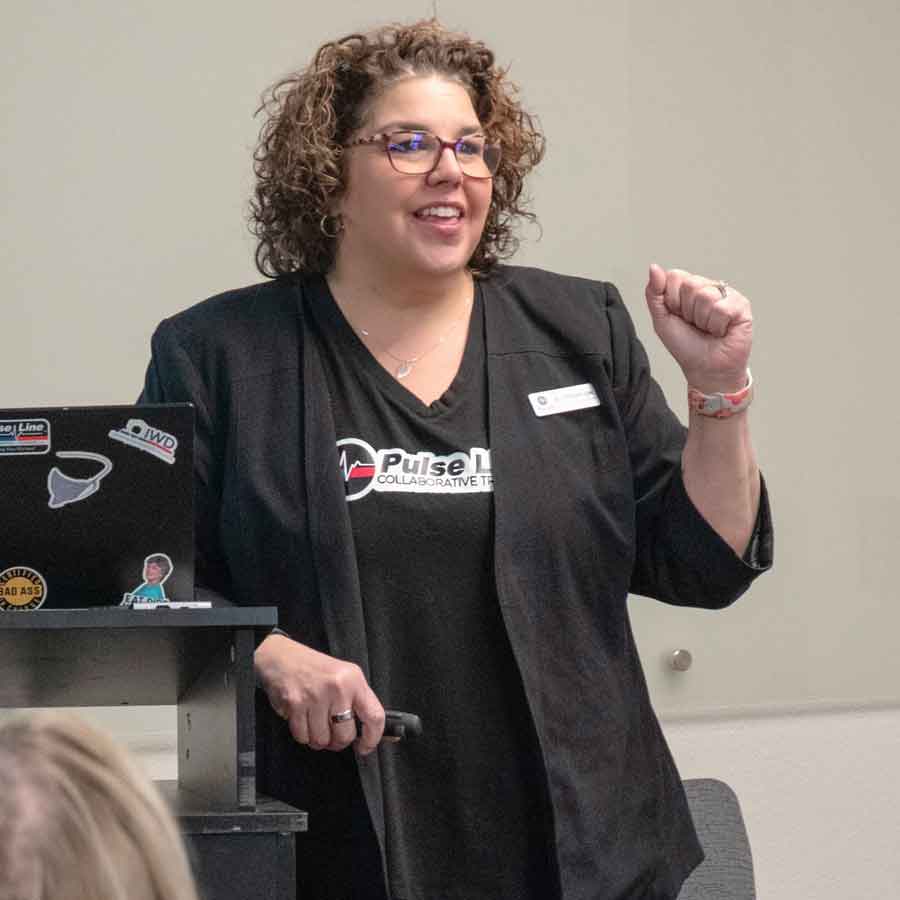
in law enforcement training concerning disability.
Evidence of that fact is borne out in Thompson’s role as the founder and CEO of Boulder, Colorado-based Pulse Line Collaborative Training, which trains law enforcement officers across the country in interacting with people with disabilities.
It was data-backed policy that sparked Thompson to found Pulse Line in 2020.
“In my work in the Colorado Attorney General’s office, I investigated at-risk crimes, those crimes against anyone 70 or older, or persons 18 and older with a disability,” she said. “A disproportionately high number of victims of violent crimes are people with disabilities, yet the investigation and prosecution of those crimes are disproportionately low.
Thompson added: “The data also showed that people with disabilities also account for a disproportionate number of negative interactions with law enforcement.”
Helping address this disparity and give law enforcement officers the tools to better serve that population became an increasingly large part of Thompson’s job
“I was learning so much about disability and began training investigators on how to investigate crimes against and interview people with disabilities. Ultimately, I began to teach around the country.”
That work ultimately led Thompson to found Pulse Line, which draws from the mission of her alma mater to reduce the pain and suffering caused by crime — and to use translational research in the form of evidence-based, data driven practices to pursue that work. Thompson conducted research including interviews with people with various disabilities to identify gaps in law enforcement training concerning disability. She ultimately created a curriculum, “Interacting with people With Disabilities” to help members of law enforcement recognize characteristics and behaviors of people with disabilities and provide communication strategies to help avoid escalation.
While Thompson’s professional roles informed her ability to work with people with disabilities —and to train others to do the same— her home life made the pursuit personal.
“My daughter has significant special needs and my son is on the autism spectrum,” she said. “Part of what sets Pulse Line apart is that all of our trainers are either current or former police officers and all of them have someone close to them that has a disability.”
Pulse Line has now trained more than 8,000 officers, including every Colorado State Trooper. Thompson noted that, from feedback surveys, 97 percent of those participants reported that they would recommend the training to other law enforcement officers.
With these successes at her back, Thompson said Pulse Line has plans to expand its training offerings.
“We’ve created other curriculums for city employees, teachers education professionals, and parents,” she said, before noting that, helping people with disabilities is its own reward. “Once you engage in that world, you see a beauty in humanity. When you can help people see that and help people with disabilities see that they have value, it is energizing.”