

The need for public colleges and universities to prove their value to the taxpayers who help fund them has never been greater. Ever-tightening budgets have narrowed the lens through which investments in public higher education and research are judged.
It is a reality Thomas Blomberg, dean of Florida State University’s College of Criminology and Criminal Justice, believes the school is well positioned to navigate. Blomberg’s confidence in his college’s current and future role is rooted in its mission to produce translational research.
“We are here to add value to society as it relates to reducing the pain and suffering caused by crime and that mission permeates everything we do in our college,” he said. “Our motto is ‘Bringing research to life.’ Translational research, and the commitment to evidence-based policy and decision making, is the means through which we pursue that goal.”
There is no doubt that the college is flourishing.
In the most recent rankings of colleges of criminology, CCCJ claimed the No. 1 and No. 2 overall spots from University Magazine and Niche, respectively. The most recent survey of faculty productivity and influence by the Journal of Criminal Justice Education placed the college’s faculty No. 1 nationally.
The consistently high rankings and broad recognition, Blomberg said, demonstrate that prioritizing translational research works. But further evidence of the college’s impact abounds.
The Aging Adult Fraud Research and Policy Institute, housed in the college’s Center for Criminology and Public Policy Research, is the national leader in the burgeoning study of fraud and financial exploitation of older adults and the translation of research into evidence-informed policies to respond to this escalating social problem.
The college is a founding partner in the Capital Region Real Time Crime Center, helping its local law enforcement partners in their 24-hour, 365-day-a-year mission to reduce and solve crime in and around Tallahassee. The CRRTCC is a joint effort with the Leon County Sheriff’s Office, the Tallahassee Police Department, the Florida Department of Law Enforcement and FSU Police Department. CCCJ is the only college to serve as an embedded research partner at a real-time crime center. The CRRTCC was named the 2024 Center of the Year by the National Real Time Crime Center Association.
Faculty are being acknowledged for their work as well. In the last year alone: Associate Professor Steven Zane’s book “Between Medicine and Criminology” was named 2025 Book of the year by the American Society of Criminology’s Dvision of Hitorical Criminology. CCCJ’s Hate Crime Research and Policy Institute, directed by Associate Professor Brendan Lantz, earned Gonzaga University’s Center for the Study of Hate Eva Lassman “Take Action Against Hate” Award. Professor Dan Mears was named editor in chief of Justice Quarterly, a top-ranked academic journal in criminology and criminal justice. Additionally, Blomberg was honored by the Florida House of Representatives for his excellence and commitment to research, teaching and public service.
Faculty make regular appearances in local and national media from reporters eager to tap the expertise of a group that produces more research in its field than any other.
“No institution has more of a focus on translational research than we do; it’s in our DNA,” Blomberg said. “I believe the influence our faculty wields and the initiatives and partnerships we have forged validates that view.”
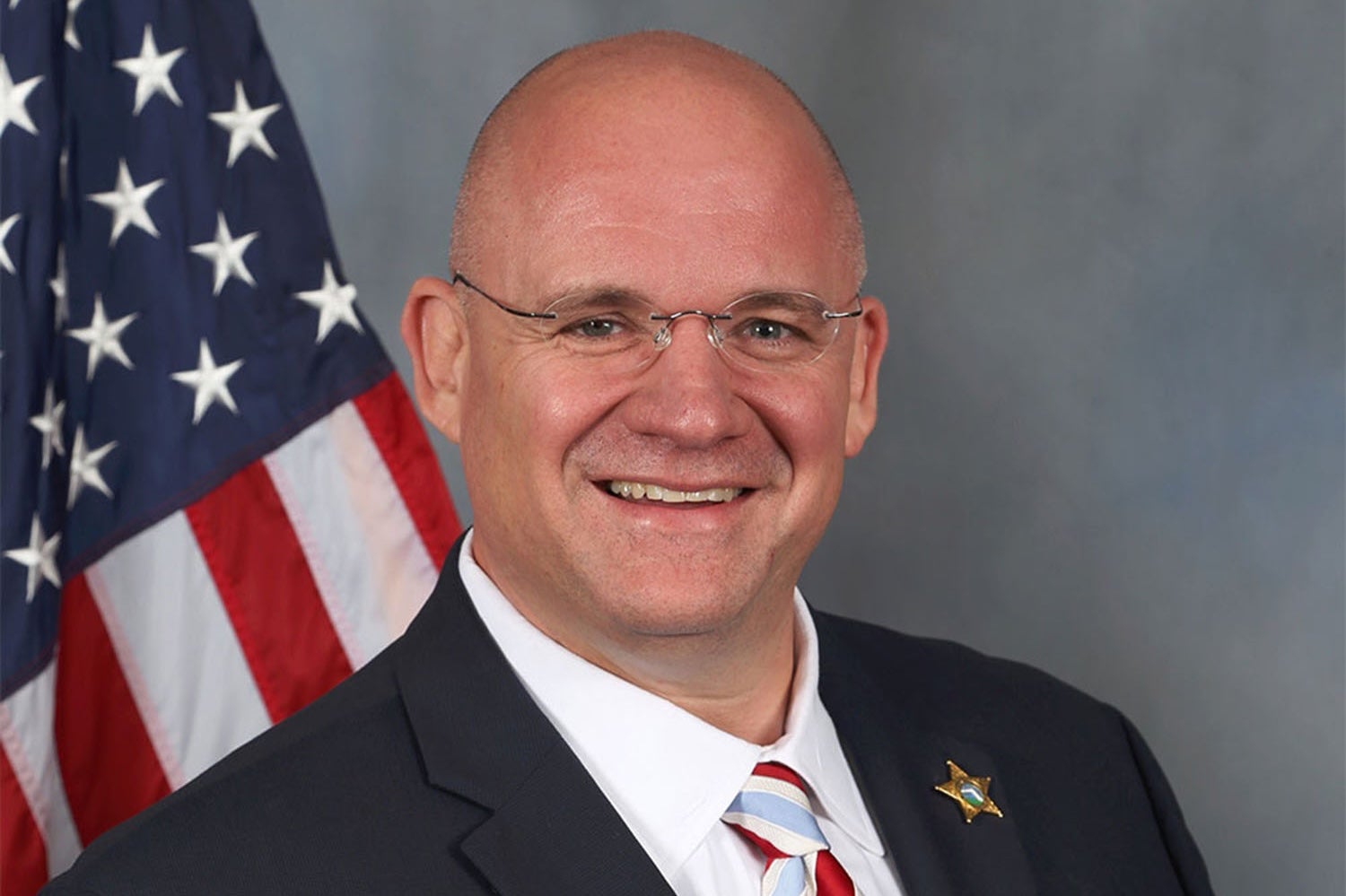
An Alum and a Believer in the Mission
Few people are better positioned to speak about the real-world impact of CCCJ’s translational focus than CCCJ alum, Walton County Sheriff, Mike Adkinson. College researchers have partnered with Adkinson’s office on a number of projects and are currently working on a study of the vocation, education, and treatment programs offered in the Walton County Jail. Among other goals, the programs aim to teach job skills and reduce recidivism.
“Research directly drives what type of opportunities and training are provided to inmates, and the type of resources provided here,” he said. “These are decisions that impact people’s lives, and we are using evidence-backed data to make them. Then we’re verifying outcomes to determine what’s working, what should be continued and what we need to adjust.”
Adkinson said research partnerships with CCCJ inform a host of decisions including where time, money and personnel are best deployed.
“These are real-world applications of taxpayer dollars that are financially viable but they are also fiscally responsible,” he said. “When a citizen or elected official asks, ‘Well, how do you know that a program is working?’ we can point them to the data —to the facts— not an opinion or an intuition.”
Adkinson added: “We are affecting and investing in people’s lives. You can’t put a price on that but you must consider the best return on investment, the best opportunity for a policy or regulation to be successful. To do that, we make decisions based on evidence.”
Adkinson said his experience as an FSU criminology student impressed upon him the value of an inquisitive mind asking practical questions. That value has only increased during his decades in law enforcement and help drive policy in his office today.
“I call it being terminally curious,” he said, before noting how that curiosity has shaped law enforcement in his office and beyond. “There were factors that were not really understood or considered 35 years ago. Things like mental health and trauma can be major drivers in impacting behavior. Those are things we understand much better now and I think that comes from being inquisitive and always looking for better approaches. Our partnership with the college feeds that pursuit.”
The college’s partnerships with the National Institute of Justice, the National Institutes of Health, the Bureau of Justice Administration, the Florida Department of Juvenile Justice, the Florida Department of Corrections, the Leon County Sheriff’s Office and the Palm Beach County Criminal Justice Commission, show other criminal justice leaders share Adkinson’s view.
Embedding Translational Research
Blomberg’s work attracting faculty either already engaged in, or set to pursue, careers with a translational focus means that translational approaches have long been part of courses taught at the college but they were not always codified in its curriculum.
In 2022, the college began a curriculum review with an eye toward further enmeshing, expanding and ultimately formalizing translational research within its course offerings.
Professor Jenn Copp helped lead the curriculum review, which is completed and currently winding its way through the university’s approval process.
“To the extent that we want the emphasis on the translational to be part of who we are and part of our legacy, we want to make sure we formalize it in classroom education,” she said. “Translational research is the future of the discipline so this endeavor is to make sure our education reflects that.”
Haley Nelson, a first-year doctoral student from Tampa, said it was the college’s focus on translating research into policy that inspired her to pursue a graduate degree during her time as an undergraduate in the college.
“Being able to actually put the work that I like doing out there and share it outside of an academic circle and potentially make changes in policies and practices was exciting,” she said. “The term ‘ivory tower’ gets use a lot with academics not making their work accessible or shareable or producing work without any policy implications. This is an opportunity to reach out and create partnerships and make change.”
Nelson’s work with CCCJ researchers includes partnering with the Community Violence Intervention and Prevention Initiative in Tallahassee. Findings from CCCJ researchers are being used by the Council on the Status of Men and Boys, a joint subcommittee of the Leon County Sheriff’s Office and the Tallahassee Police Department.
Change Awaits
With the dawn of another academic year less than two months away and a host of changes awaiting — including renovation and construction projects that will add 50,000 square feet of space for teaching, research and extending partnerships into embedded relationships with policy makers, practitioners and interested citizen groups— the college is poised to fulfill its mission “Bringing research to life.”
“We are here to make a difference,” Blomberg said. “It pleases me to see that we are doing just that.”