

A career fueled by turning research and evidence into real-world policies and practices has earned Thomas G. Blomberg, dean of Florida State University’s College of Criminology and Criminal Justice, the 2026 August Vollmer Award, from the American Society of Criminology (ASC).
Blomberg’s decades of translational research in criminology and criminal justice earned him the Vollmer Award, which is regarded as one of the most prestigious honors in the field.
The ASC defines the award as recognizing an individual whose “scholarship and professional work have made outstanding contributions to justice and the treatment or prevention of criminal or delinquent behavior.”
Blomberg, the Sheldon L. Messinger Professor of Criminology, is a three-degree graduate of UC, Berkeley, including a doctorate in criminology. Years after joining the College’s faculty, he became dean in 2003 and has earned a place as one of the most influential thinkers and leaders in his field.
Citing his unparalleled and “outstanding contributions to justice and to the treatment and prevention of crime,” the three authors of his nominating letter noted Blomberg’s prolific rate of publication, his promotion of evidence-based policy and his efforts to strengthen the field of criminology and criminal justice” in endorsing him for the award.
Dan Mears, Mark C. Stafford Professor of Criminology in the college, co-authored the nominating letter. Mears called Blomberg an essential reason he came to Florida State and said the diversity of Blomberg’s contributions to the field of criminology set him apart.
“He’s led a college, won teaching and mentoring awards, presented before legislatures, written books and given presentations internationally,” Mears said. “Tom’s longevity, his diversity of contributions and his persistent framing of science to inform policy and practice are unique. The Vollmer Award is clearly about all those things and Tom checks all those boxes.”
Malcolm Feeley, Claire Sanders Clements Dean’s Professor of Law, Emeritus at UC Berkeley has known Blomberg for 50 years also co-authored the nominating letter. Feeley noted that the award’s namesake, August Vollmer, was the founder of both UC Berkeley’s School of Criminology and the ASC. The list of Vollmer Award winners, Feeley said, constitutes a “hall of fame,” for criminology and criminal justice professionals.
“The list of winners includes a U.S. Senator, eight federal judges, two former longtime directors of the National Council on Crime and Delinquency and a handful of the most honored police chiefs in the history of the country,” he said. “It’s a mindboggling list, and Tom certainly deserves to be on it.”
In his time at FSU, Blomberg has authored and co-authored scores of published studies, co-authored American Penology: A History of Control, a seminal book in the field which was cited by the U.S. Supreme Court. He has lent his expertise in appearances before the U.S. Congress, foreign governments, state and local governments and leading media outlets including: the Wall Street Journal, The Washington Post, New York Times, the NBC Today Show, NBC Nightly News,CBS Evening News, PBS Inside the Law Series, the BBC, and NPR.
Under his leadership as dean, the College has climbed national rankings of colleges of criminology and criminal justice and today ranks as the top criminology program in the world.
“Through the years, I’ve been the beneficiary of some fortunate circumstances,” Blomberg said. “This award is a surprise and an incredible honor but ultimately it’s a reflection of this University, College, our wonderful faculty and staff and, of course, our students.”
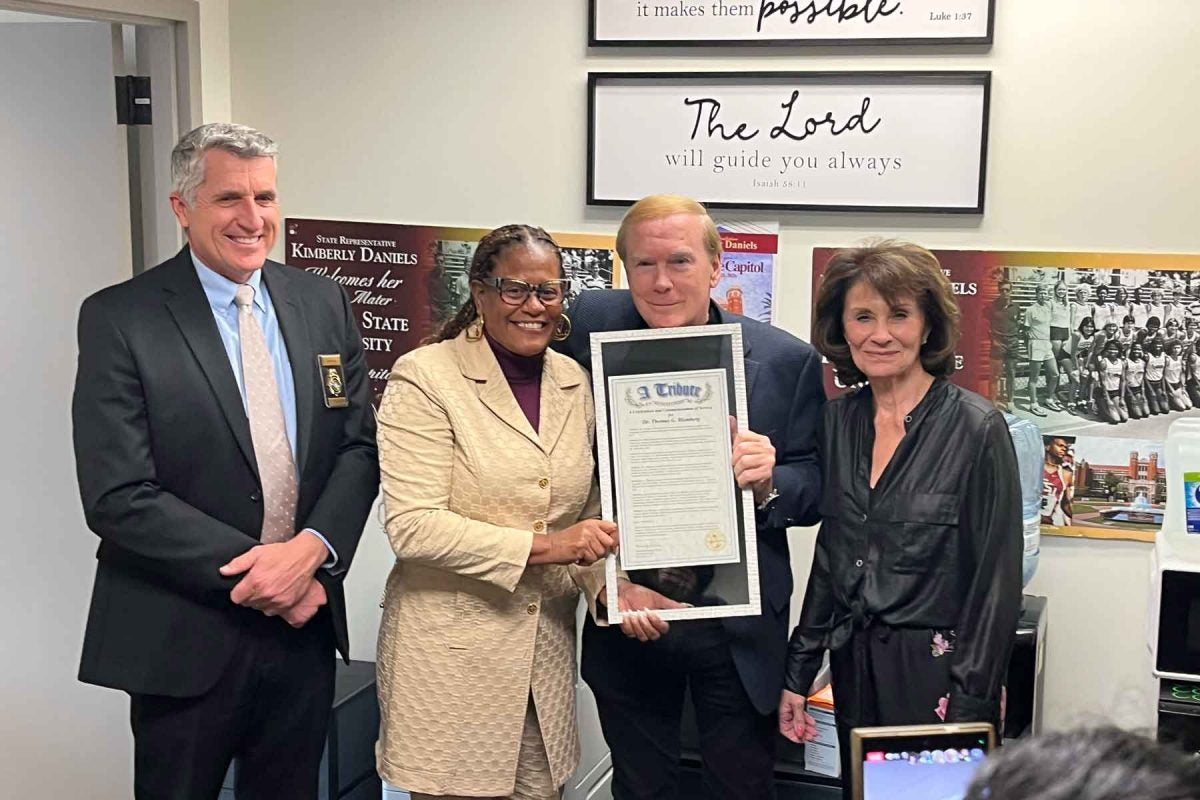
Motivated by bringing research to life
Jeanine Blomberg first met her husband Tom when the two were in middle school in Berkeley, California. Later they moved to Tallahassee and raised their son Thomas Jr., who is an attorney —and graduate of UC, Berkeley Law School. Their grandson Jacob is set to enroll as a graduate student at UC, Berkeley this fall. Through a lifetime together, she’s observed the many ways Tom’s sense of purpose and passion to make positive change have fueled him.
“When he was 15 years old, he was talking about what he was going to do with his life,” she said. “Since he was a young man, he’s had a boundless motivation for making a difference.”
In his work as a researcher, that meant pursuit of a goal as deceivingly simple as it was ambitious: to reduce the pain and suffering caused by crime. To do that, Blomberg believed research needed to be translated into a force for shaping real-world policies and practices. That belief would form the bedrock of his scholarship and inform his leadership of the College.
From the College’s motto “Bringing Research to Life,” to assembling the practice-and-policy-driven researchers who comprise its faculty —which is the nation’s most prolific— Blomberg’s goal to produce translational research has permeated.
Associate Professor George Pesta, director of the College’s Center for Criminology and Public Policy Research, has worked with Blomberg for 30 years and watched his ethos of translational research take root.
Pesta singled out the Juvenile Justice Educational Enhancement Program (JJEEP) as being among Blomberg’s most impactful projects.
“His research conceptualization and implementation of JJEEP was truly translational and, for those involved, transformative,” Pesta said. “He embedded researchers in a statewide accountability system for the education of incarcerated youth where we worked with state agencies, local school districts, and private providers of juvenile justice services.”
Pesta added: “From 1998 to 2010, JJEEP developed, implemented and maintained a research-driven system that guided policy and improved educational program performance for thousands of Florida delinquent and at-risk youths. At its peak, there were more than 200 juvenile justice education programs in Florida serving 30,000 youths each year.”
Blomberg has delivered multiple reports and presentations to the Florida Legislature and to the U.S. Congress and received federal funding to promote JJEEP’s model throughout the country.
“Through JJEEP, Tom influenced state policy, helped enshrine research into state statute, improved services for incarcerated youth and, most importantly, he made a difference in the lives of tens of thousands of youths in Florida and the country,” Pesta said. “For me, and many others, JJEEP fundamentally shaped our career trajectories. It trained us in how to participate in translational research and use it to improve lives. The lessons I learned at JJEEP guide me today. Without it, I would not have spent a career in research.”
LISTEN TO WFSU'S STORY
Building a college into a national leader
Todd Clear, professor at Rutgers University, worked at the College for several years and co-authored the letter nominating Blomberg for the Vollmer Award.
“Tom is an accomplished scholar and he made his mark through his research and creating a framework and an energy behind what was then a new idea of translational criminology,” Clear said. “But he also made his mark in the many of (the College's) alumni who have made exactly the contributions that the Vollmer Award stands for. He set a tone for the school to care about that kind of work, and the students who leave there carry on that vision.”
Clear is the founding editor of the Journal of Criminology and Public Policy and said Blomberg’s help was instrumental helping grow the journal from a promising publication to an influential source for policy-relevant research, including serving as its editor from 2007-2013.
“Tom’s career, his ability to build bridges and lead that program and make it one of the top programs in the country, he’s a really good example of what the Vollmer Award is for,” Clear said.
Assistant Professor Julie Brancale first met Blomberg as a criminology undergraduate student preparing to take the next step in her education in law school. Brancale said she sought Blomberg’s advice and hopefully a letter of recommendation for her application to the UC Berkeley Law School. He agreed to write the letter of recommendation to his alma mater and that is where Brancale said Blomberg asked her a question that changed her life.
“He asked me what I wanted to do with my law degree,” she said. “I knew I liked school and I was good at school but the directness of that question showed me it was something I hadn’t really thought through.”
Subsequent conversations with Blomberg and an invitation to join him on a research project opened a new path for Brancale, even after being accepted for admission by UC Berkeley and other top law schools.
“I wanted to help people, to make a difference and to leave a positive mark on the world,” she said. “Tom really took me under his wing and showed me what translational research was and what kind of impact it could have on society and how it could make positive change. These were all things I wanted to do with my life.”
Today, Brancale is the co-director with Blomberg in the College’s Aging Adult Fraud Research and Policy Institute, leading the nation in researching an emerging field that impacts millions of older adults in the US and abroad.

A capstone but not an end
Beginning this year, FSU’s College of Criminology and Criminal Justice is set to embark on a renovation of the Kellogg Building, located next-door to its current home. The project, which will add 50,000 square feet of space to the College, is set to happen 75 years after the first criminology courses were offered at FSU.
Blomberg has shaped the course of the College more than any other figure. The new building projects and his leading role in the burgeoning study of aging adult fraud and financial exploitation offer new motivations. But the Vollmer Award puts the spotlight on his long-held desire to make a difference.
“It’s the thread through all of his work,” Jeanine said. “It’s the connection between research and policy and he’s still so excited to make it.”
Those who know and work with Blomberg can tell you that emails arrive at all hours of the day from his computer, offering feedback on research, status updates on the college, notes to colleagues and, along the way, evincing the passion that fuels him.
“I was at my computer and it was 2:30 in the morning when I got the news about the Vollmer Award,” he said with a laugh. “I love my job and the cumulative experience of my life, the memories I’ve made, the happy faces of students graduating, faculty earning tenure, what more could anybody ask for? What an honor. What a privilege.”
Blomberg added: “If there is one single thing that’s salient in any success I’ve had, it’s Jeanine. When I think about how brilliant she is, the wise counsel she’s given me, and how she’s able to help me see things I’d never otherwise see, I am humbled.”
For her part, Jeanine said the feeling is mutual and the man Blomberg is today still resembles the boy she met years ago.
“I’ve had a front row seat watching him for so long and seen his true beliefs in action and I still see after all these years that he finds such incredible enjoyment and fulfillment when he is teaching and interacting with students, when he is doing research and, most importantly, when there is an impact in the real world,” she said. “This award is an incredible recognition, but I’ve been amazed by his commitment to making a positive difference throughout his life."
Blomberg will be honored in person at the ASC's annual meeting in Chicago this November.